The Secondhand Ecosystem: Your Guide to Thrift Stores, Consignment, Vintage and Everything In Between
Not all secondhand stores are created equal. From the chaotic charm of a thrift store to the curated world of vintage boutiques, the lively haggling of a flea market, and the driveway deals of a garage sale — here's your guide to navigating the entire secondhand ecosystem like a pro.
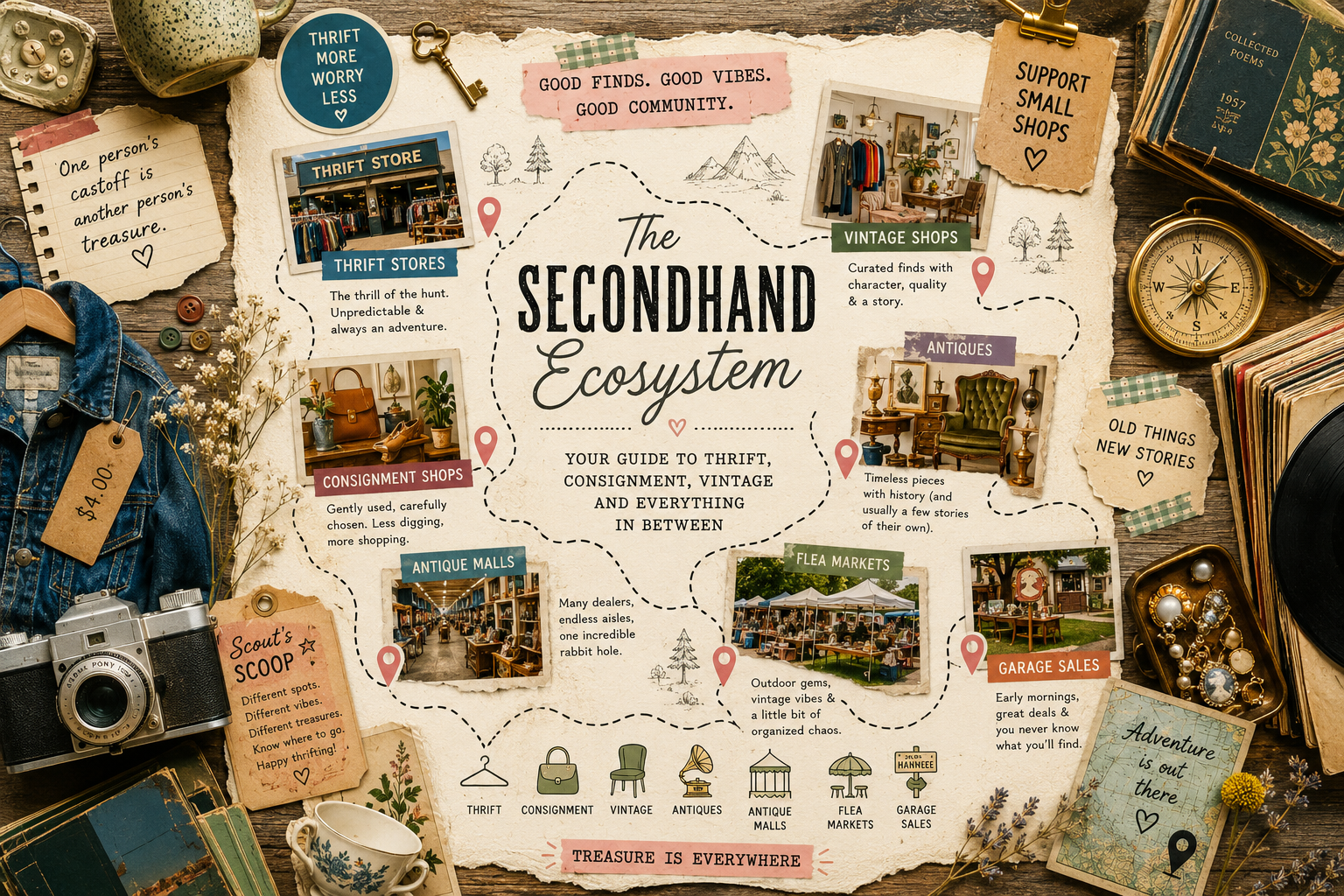
Whether you're exploring thrift stores in Vancouver, hunting vintage finds in New Westminster, or planning a weekend treasure hunt somewhere in the Lower Mainland, knowing the type of store you're walking into makes all the difference.
There are moments every seasoned thrifter knows. You walk through the door, the smell of "other people's stuff" hits you, someone is inexplicably blocking the entire housewares aisle with their cart, a stranger materializes beside you at the exact rack you were working through despite the entire store being empty, and a staff member is already announcing over the PA that the store closes in thirty minutes even though you just got there.
And yet you stay. Because somewhere between the mismatched mugs and the rack of anonymous blazers, something catches your eye. You pull it out. It's perfect. It's $4.99. And just like that, you get it.
Welcome to thrifting. It's chaotic, occasionally frustrating, and completely addictive.
But here's something even seasoned thrifters don't always think about: not all secondhand stores are the same. The thrill of the hunt looks a little different depending on where you're hunting. Knowing the difference can save you time, money, and the mild agony of driving across town only to find a store that doesn't carry what you're looking for.
So let's break it down.
Thrift Stores
The Wild West Of Secondhand Shopping
Thrift stores are the great equalizer. Donations come in from everywhere — estate cleanouts, closet purges, the mystery bags of stuff people drop off without a second thought — and everything gets priced fast and put on the floor. Nobody is curating this. That's the point.
The prices are low, the inventory is unpredictable, and the experience ranges from "I can't believe this exists" to "I cannot believe someone donated this." Both reactions are valid. Both happen regularly.
Thrift stores are best for finding everyday essentials on a budget, hunting for hidden gems, home goods, books, and the kind of random discoveries you didn't know you needed.
Scout's Scoop: Many thrift stores rotate colour coded discount tags on a weekly basis, meaning certain tag colours are on sale at different times. It's worth asking staff which colour is discounted on the day you visit. Seasoned thrifters often know the rotation by heart and plan their visits accordingly.
Consignment Shops
Someone Already Did The Hard Work For You
Consignment stores are thrift stores with a filter. Sellers bring in their items, the store decides what to accept, and if it sells, the seller gets a cut. This means the inventory is more curated, the condition is generally better, and the prices reflect that.
You're less likely to find a $2 treasure but more likely to find exactly what you were looking for without digging through seventeen things that aren't it. Consignment stores are best for specific items, higher-end brands, clothing in excellent condition, and shopping when you don't have two hours to spare.
Scout's Scoop: End of season is your friend. Items that haven't sold get marked down or pulled, which means great deals right before the inventory turns over. If you've had your eye on something that feels a little out of your budget, patience sometimes pays off.
Vintage Stores
Where Thrifting Gets A Little Fancy
Vintage stores are intentional. The owner has done the sourcing, the sorting, and the styling for you. Everything in the store is there on purpose, priced to reflect its era, its condition, and honestly, its vibe.
Prices are higher than a thrift store, sometimes significantly, but you're paying for curation and the guarantee that someone who actually knows what they're looking at decided this piece was worth carrying.
Vintage stores are best for statement pieces, specific decades, quality over quantity, and when you want to feel like you're shopping rather than excavating.
Scout's Scoop: Build a relationship with the owner if you can. Vintage store owners are passionate about what they do and they often hold pieces for regulars or tip you off when something in your wheelhouse comes in. A little friendly conversation goes a long way.
Antiques and Collectibles
For the Patient And The Passionate
Antique stores occupy their own universe. We're talking serious age here — true antiques are generally considered to be 100 years old or more, though you'll often find dealers using the term loosely for anything that feels old, rare, or collectible. Items in that 20 to 99 year range technically fall into vintage or collectible territory, but honestly the lines blur at the edges and most dealers aren't pulling out a calculator.
The prices reflect rarity and age, not just secondhand status. You're not going to find a $5 lamp here. But you might find the lamp.
Antiques and collectibles stores are best for serious collectors, unique home décor, furniture with history, and anyone who finds joy in objects that have already lived a full life.
Scout's Scoop: Don't be afraid to ask questions. Antique store owners and dealers are usually encyclopedias of knowledge about what they carry. If you're not sure what something is or whether it's a good find, just ask. You'll either learn something or confirm you've found a gem.
Antique Malls
Where You Go in For One Thing And Come Out Three Hours Later
If a regular antique store is a novel, an antique mall is an entire library. These are large shared spaces where multiple independent dealers each rent their own booth, section, or row of shelving, filling it with whatever their particular passion happens to be. One corner might be mid-century furniture. The next is vintage jewelry. Around the bend is someone who has committed entirely to vintage barware and is not apologizing for it.
The result is an overwhelming, wonderful, completely chaotic browsing experience. Be prepared to stand in the middle of an aisle and just slowly turn in a circle for a full five minutes trying to take everything in. There is simply a lot going on. That is the point and also part of the charm.
Because each dealer sets their own prices and runs their own little shop within the shop, the range of what you'll find and what you'll pay varies wildly. That's part of the adventure.
Antique malls are best for variety seekers, dedicated browsers, collectors hunting across multiple specialties, and anyone who considers "I have no idea how long I was in there" a successful outing.
Scout's Scoop: Go with time and comfortable shoes. This is not a quick errand. Treat it like a day out.
Garage Sales
Someone Else's Clutter, Your Potential Treasure
Garage sales are the most personal format in the entire secondhand ecosystem. You're not walking into a store — you're walking into someone's life. The stuff on those folding tables and blankets spread across the driveway was in someone's home last week, and now it's yours for a dollar if you want it.
Garage sales are arguably where you'll find the best deals. There's no overhead, no middleman, and most people just want things gone. That said, every seasoned thrifter has pulled up to a sale where someone has priced a used candle holder at $18 and a scratched picture frame at $25 with complete confidence. It happens. You smile, you move on, and you hope the next driveway is more reasonable.
Garage sales are best for household items, tools, kids stuff, furniture, and the kind of jaw-dropping find that the seller genuinely had no idea was valuable.
Scout's Scoop: Show up early for the best selection and late for the best prices. Sellers in the last hour would often rather let things go for almost nothing than pack it all back inside
Flea Markets
The Speed Dating Of The Secondhand World
Flea markets are kind of like the speed dating of the secondhand world. You show up, you scan, you interact with the owner, you move on, and somewhere in the whirlwind you might just find the one. They are interesting, a little unpredictable, and can be one of the most entertaining ways to spend a Saturday morning — even if you leave empty handed.
Vendors set up their own stalls selling everything imaginable. Vintage clothing, tools, records, jewelry, housewares, art, car parts, plants, electronics, sporting goods, and at least one table of completely unidentifiable objects that someone is inexplicably confident about pricing at $40. The variety is part of the experience. So is the people watching.
Flea markets come in different formats. Some are outdoor pop-up style events held in parking lots or fairgrounds on weekends, seasonal and fleeting. Others are more permanent indoor setups where vendors rent individual cubbies or booths year-round, giving them the lively energy of a flea market with the stability of a fixed location. Both are worth exploring.
Here is the thing though. Most items at a flea market don't have price tags. That means you are going to need to ask. And if you want a deal, and you should want a deal, you are going to need to negotiate. Bartering is completely normal here. Sellers expect it. A friendly "would you take $X for this?" is not rude, it's just how flea markets work.
If the idea of negotiating makes you want to disappear into the earth, flea markets are still worth visiting just for the atmosphere and entertainment. But if you can get comfortable with a bit of friendly back and forth, you'll consistently walk away with some of the best deals in the entire secondhand ecosystem.
Flea markets are best for weekend adventures, one-of-a-kind finds, vintage and antique browsing, and anyone who enjoys a side of lively conversation with their bargain hunting.
Scout's Scoop: Be friendly, be reasonable, and don't lowball someone on something they clearly care about. A genuine compliment about the item before you negotiate never hurts either. People like selling to people who appreciate what they're selling.
Specialty Resale
Secondhand, But Make It Niche
Specialty resale stores focus on one category and go deep. Record stores, used bookshops, furniture resellers, sporting goods, musical instruments — these stores exist because some things deserve their own ecosystem.
If you're looking for something specific, a specialty resale shop run by someone who genuinely loves that category will almost always beat a general thrift store for selection and knowledge.
Specialty resale is best for targeted shopping, finding something specific, and talking to someone who actually knows what they're selling.
Scout's Scoop: Don't overlook the staff. Someone who has spent years running a used record shop or a secondhand bookstore is a walking encyclopedia. Ask them what's good. You'll rarely be disappointed.
So Which One Should You Go To?
Honestly? All of them. Just maybe not all on the same day.
The secondhand world isn't one-size-fits-all, and that's exactly what makes it interesting. Some days you want the chaos of a thrift store and the dopamine hit of an unexpected find. Some days you want to walk into a consignment shop and leave in twenty minutes with exactly what you needed. Some days you want to stand in an antique mall for two hours and emerge with something you can't quite explain but absolutely had to have. And some days you want to haggle with a stranger over a vintage lamp at a flea market while someone nearby tries to sell a set of golf clubs and a taxidermied squirrel.
That's the secondhand ecosystem. And ThriftScout exists to help you navigate all of it — because knowing where to look is half the fun.
Explore thrift, consignment, vintage, antique and specialty resale stores across Vancouver and the Lower Mainland with thriftscout.ca